Team Building Activities for Small Groups: 20+ Ideas That Actually Work

Discover 20+ team building activities designed specifically for small groups of 5-15 people. Get practical ideas that build trust, boost collaboration, and actually engage your team—from scavenger hunts to problem-solving challenges.
When you're managing a small team of 5-15 people, traditional large-group team building activities often fall flat. Activities designed for 50+ employees can feel awkward, impersonal, or just plain boring when your whole team fits around a conference table.
Small groups need different approaches—activities where everyone participates, conversations happen naturally, and genuine connections form. Here are 20+ team building activities specifically designed for small groups, plus practical tips for making them work.
Why Small Group Team Building Is Different
Small teams have unique advantages that large groups don't:
Deeper connections form faster. With fewer people, everyone gets meaningful face time. No one disappears into the crowd or gets stuck on the sidelines.
Everyone's voice matters. In a team of eight, every person's input is noticeable. Quiet team members can't hide, and dominant personalities can't steamroll the group as easily.
Logistics are simpler. Booking a room, ordering lunch, or organizing transportation is exponentially easier with 10 people than with 100.
Trust builds differently. Small groups can tackle vulnerable, personal activities that would feel uncomfortable in a large corporate setting. You can have real conversations instead of surface-level networking.
The downside? You can't rely on "crowd energy" to carry mediocre activities. Everything needs to be engaging because everyone will notice if it's not.
Best Team Building Activities for Small Groups (5-15 People)
Here are proven activities that shine with small teams:
1. Custom Scavenger Hunts
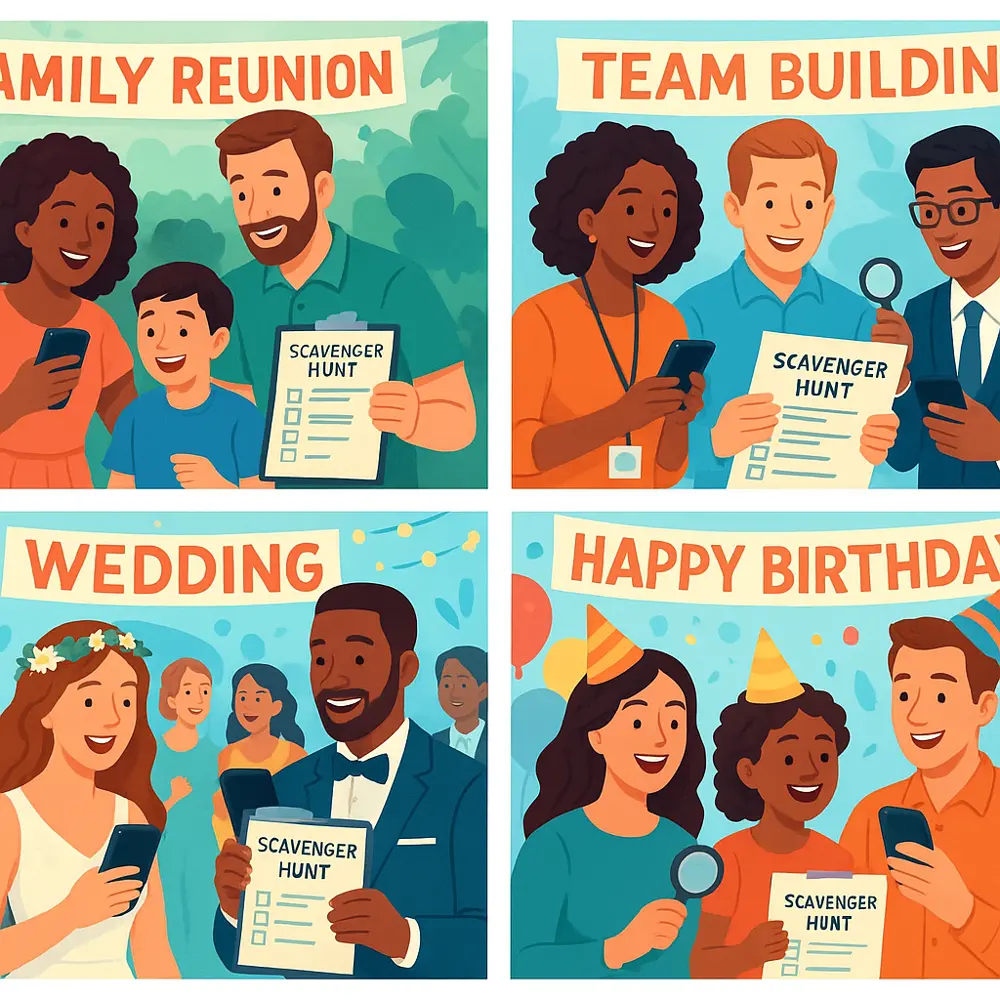
Scavenger hunts adapt perfectly to any group size, but they're especially engaging for small teams where everyone stays involved.
Why it works: Combines problem-solving, creativity, exploration, and friendly competition. Can be done indoors, outdoors, or hybrid.
How to run it: Use Seekr to create a custom scavenger hunt tailored to your office, neighborhood, or event. Include photo challenges, trivia about your team, location-based tasks, and creative prompts. Teams of 2-4 work together to complete challenges.
Time needed: 45-90 minutes
2. Escape Room Challenges
Book a local escape room or create your own puzzle sequence. Small groups excel here because everyone needs to contribute to solve the puzzles in time.
Why it works: Forces collaboration under pressure, rewards different thinking styles, and creates shared victory moments.
Time needed: 60 minutes
3. Two Truths and a Lie (Deep Version)
Everyone shares three statements about themselves—two true, one false. The group guesses which is the lie. For small groups, encourage stories that go beyond surface facts.
Why it works: People learn surprising things about colleagues they thought they knew. Works great for new teams or teams that have worked together for years.
Time needed: 20-30 minutes
4. Speed Networking Rounds
Set a timer for 3-5 minutes. Each person pairs up and discusses a prompt ("What's a skill you want to learn?" or "Tell me about your first job"). When time's up, rotate partners.
Why it works: Structured but personal. Everyone talks to everyone. Great for new teams or cross-functional groups.
Time needed: 30-45 minutes (depending on group size)
5. Collaborative Building Challenges
Give teams limited materials (paper, tape, straws, etc.) and a challenge: build the tallest tower, create a bridge that holds weight, or construct a working catapult.
Why it works: Reveals problem-solving approaches, encourages creativity, and produces tangible results. Low-pressure competition with high engagement.
Time needed: 30-60 minutes
6. Minute-to-Win-It Games
Quick, silly physical challenges using office supplies. Stack cups, bounce ping pong balls, balance cookies on foreheads, transfer items with chopsticks.
Why it works: Fast-paced, high-energy, and hilarious. Breaks down professional walls quickly.
Time needed: 30-45 minutes (multiple rounds)
7. Story Building
One person starts a story with a single sentence. Each person adds one sentence, building on what came before. Can be serious, silly, or themed around your company.
Why it works: Encourages active listening, creativity, and adaptability. Low-stakes and accessible to all personality types.
Time needed: 15-20 minutes
8. Office or Team Trivia
Create trivia questions about your company history, team members, inside jokes, or industry knowledge. Form small teams or play individually.
Why it works: Celebrates shared knowledge, surfaces forgotten stories, and includes everyone (no physical requirements).
Time needed: 30-45 minutes
9. Problem-Solving Scenarios
Present a hypothetical challenge relevant to your work ("We have 24 hours to launch a product with half our team sick—what do we do?"). Teams brainstorm solutions and present their approach.
Why it works: Develops strategic thinking, surfaces different perspectives, and can inform real decisions.
Time needed: 45-60 minutes
10. Creative Challenges
Give everyone the same materials and 20 minutes to create something: a marketing campaign, a product design, a short video, a team logo.
Why it works: Taps into creativity, allows non-traditional skills to shine, and produces artifacts you can keep.
Time needed: 30-60 minutes
11. Show and Tell
Each person brings an object (physical or digital) that represents something meaningful to them—a hobby, a memory, a value—and shares the story behind it.
Why it works: Deeply personal but opt-in. Builds empathy and understanding. Works especially well for remote teams over video.
Time needed: 30-45 minutes
12. Skills Swap Workshop
Team members teach each other skills in short sessions. Someone teaches a software shortcut, another demonstrates a cooking technique, another shares a language phrase.
Why it works: Everyone has expertise to share. Roles shift from usual work hierarchy. Actually useful.
Time needed: 60-90 minutes
13. Cooking or Baking Challenge
Order identical ingredient kits or assign a category ("best sandwich"). Everyone creates something, then you share and judge (or just eat together).
Why it works: Sensory, social, and produces a shared meal. Great for virtual teams (everyone cooks at home, then eats "together").
Time needed: 60-90 minutes
14. Volunteer Together
Pick a local cause and spend a few hours contributing as a team. Food banks, park cleanups, animal shelters, and mentoring programs often welcome small groups.
Why it works: Creates meaning beyond work. Builds team identity around shared values.
Time needed: 2-4 hours
15. Walking Meetings with Challenges
Take a regular meeting outdoors and turn it into a walk. Add mini-challenges along the way using Seekr: find specific landmarks, take team photos, answer reflection questions.
Why it works: Fresh air, movement, and novelty boost creativity. Walking side-by-side feels less formal than sitting across a table.
Time needed: 30-60 minutes
16. Icebreaker Bingo
Create bingo cards with prompts like "Has lived in three countries," "Speaks two languages," "Has run a marathon." People mingle to find colleagues who match each square.
Why it works: Structured mingling for teams that don't know each other well. Low-pressure and inclusive.
Time needed: 20-30 minutes
17. Would You Rather Debates
Pose "Would you rather" questions (silly or serious) and split the room. Each side argues their position, then people can switch sides if convinced.
Why it works: Reveals values and priorities in a playful way. Encourages persuasive thinking and active listening.
Time needed: 30 minutes
18. Team Timeline
Create a visual timeline on a wall or whiteboard. Each person adds key moments from their life and career. Discuss overlaps, parallels, and surprises.
Why it works: Builds historical perspective. Shows how diverse paths led to this team.
Time needed: 45-60 minutes
19. Goal-Setting Sessions
Individually, then as a group, identify goals for the quarter or year. Share personal development goals, team objectives, and how you'll support each other.
Why it works: Practical and meaningful. Creates accountability and alignment.
Time needed: 60-90 minutes
20. Appreciation Circles
Sit in a circle. Each person shares something they appreciate about the person to their left (or another structured format). Keep it specific and genuine.
Why it works: Builds psychological safety. Ends sessions on a positive note. Everyone leaves feeling valued.
Time needed: 20-30 minutes
How to Run Small Group Team Building with Seekr
Seekr is purpose-built for creating custom scavenger hunts and challenges that work perfectly for small teams:
1. Choose your format: Indoor office hunt, outdoor exploration, photo challenge, trivia quest, or hybrid.
2. Build your tasks: Add location-based tasks, photo challenges, questions, and creative prompts. Tailor everything to your team's interests and inside jokes.
3. Add verification: Use AI photo verification for challenges like "Find something purple" or "Take a team jump photo." Manual approval for text-based responses.
4. Set teams: Divide your small group into teams of 2-4. Everyone stays engaged.
5. Launch and track: Send the hunt link, watch progress in real-time, and see results instantly when teams finish.
Example small group hunts:
- Office onboarding hunt: New hire explores the office, meets key people, learns company history
- Neighborhood exploration: Team discovers local coffee shops, murals, and hidden spots near the office
- Team trivia quest: Answer questions about colleagues, company milestones, and shared experiences
- Creative photo challenge: Complete 20 funny or artistic photo prompts around your workspace
Create your first hunt at seekrgames.com—free to start, no app required.
Quick Team Building Ideas for Small Teams
Don't have 90 minutes? Try these:
5-10 minutes:
- Rose/Thorn/Bud check-in (something good, something challenging, something you're looking forward to)
- One-word feelings check
- Quick stretch or breathing exercise together
- Random question generator (fun rapid-fire questions)
15-20 minutes:
- Two truths and a lie
- Photo challenge ("Everyone find and share a photo on your phone that represents your weekend")
- Office scavenger hunt (find 5 specific items fast)
- Lightning brainstorm (rapid ideation on a fun topic)
30 minutes:
- Collaborative problem-solving (one real work challenge)
- Skills demonstration (someone teaches a quick skill)
- Team retrospective (what's working, what's not)
- Pictionary or charades with work-related themes
Tips for Successful Small Group Team Building
Make it voluntary when possible. Forcing participation breeds resentment. Pitch activities genuinely and let people opt in.
Match activities to energy levels. Monday morning? Keep it mellow. Friday afternoon? Go high-energy or send people home early.
Read the room. Small groups surface discomfort fast. If an activity isn't landing, acknowledge it and pivot. "This isn't working—let's try something else."
Balance comfort and stretch. Some activities should feel easy and fun. Others should push people slightly outside their comfort zones. Alternate between the two.
Debrief meaningfully. Don't just do an activity and move on. Ask: What did you notice? What surprised you? How does this apply to our work?
Avoid forced vulnerability. Trust-building activities should create space for openness, not demand it. Give people opt-outs for personal questions.
Consider personality types. Include activities that suit introverts (reflective, written, one-on-one) and extroverts (group, verbal, high-energy).
Make it regular, not rare. Monthly or quarterly small activities build culture better than one annual big event.
Get feedback. After activities, ask what worked. Small groups can give honest input that improves future sessions.
FAQ About Team Building for Small Groups
How many people is considered a small group for team building?
Typically 5-15 people. At this size, everyone can participate actively in discussions, activities work without complex logistics, and personal connections form naturally. Teams smaller than 5 might skip structured activities entirely. Groups larger than 15 often need different facilitation approaches.
What's the best team building activity for a team of 5?
For very small teams, choose activities where everyone has a clear role. Escape rooms, collaborative problem-solving challenges, in-depth conversation exercises (like show and tell), and custom scavenger hunts work well. Avoid activities that require large teams or where people might sit out.
How long should small group team building activities last?
Most effective activities last 30-90 minutes. Shorter than 30 minutes feels rushed. Longer than 90 minutes risks disengagement unless it's a special event. For ongoing culture-building, do 30-minute activities monthly rather than rare all-day events.
Can you do team building activities remotely with small groups?
Yes—small groups often translate better to remote than large groups. Virtual escape rooms, online trivia, show and tell over video, cooking challenges where everyone makes the same recipe, and remote scavenger hunts (find items in your home) all work well. Small size means everyone stays visible and engaged.
How often should small teams do team building?
Monthly or quarterly works well for intentional team building activities. For very small teams (under 8), informal bonding through shared meals, coffee chats, or casual hangouts can happen more frequently. Balance structured activities with organic socializing.
What are some free team building activities for small groups?
Walking meetings, two truths and a lie, story building, appreciation circles, problem-solving discussions, would you rather debates, team timeline exercises, and skills swaps require no budget. Office-based scavenger hunts using items you already have work well too. Seekr offers free plans to create simple scavenger hunts without cost.
Small group team building is an opportunity—not a limitation. With the right activities, small teams build deeper trust, stronger collaboration, and more authentic relationships than large groups ever could.
Start with one activity from this list this month. See what resonates. Iterate. Your team of 8 will feel more connected than a department of 80 after a catered lunch and trust falls.
Create a custom team building scavenger hunt at seekrgames.com and make your next small group activity one people actually want to attend.