College Campus Scavenger Hunt Ideas: 50+ Fun Activities for Students & Groups

Discover 50+ college campus scavenger hunt ideas organized by type (exploration, bonding, photo, trivia, hidden gems). Complete step-by-step guide on how to run with Seekr Games, 10 pro tips, 12 comprehensive FAQ answers, and specialized tracks for grad students, international students, and different campus sizes. Perfect for orientation, RA training, Greek life, departments, leadership programs, and student organizations.
College Campus Scavenger Hunt Ideas: 50+ Fun Activities for Students & Groups
Need a way to get students excited about exploring campus, bonding as a team, and having real fun? A college campus scavenger hunt does exactly that. Whether you're running orientation week, training resident advisors, planning a fraternity or sorority event, coordinating graduate programs, or organizing a student organization activity, a well-designed college campus scavenger hunt transforms the campus into an adventure playground.
This comprehensive guide walks you through everything you need to know to plan and execute a successful college campus scavenger hunt. From 50+ specific hunt ideas organized by type and difficulty to advanced setup tips to how Seekr Games makes it all easier, we've got you covered.
Why College Campus Scavenger Hunts Work So Well
Campus scavenger hunts aren't just games—they're strategic tools for building community, fostering connections, and creating lasting memories on campus.
Here's why college campus scavenger hunts are so effective:
Campus Familiarity: New students learn where buildings, departments, landmarks, and resources are located in a fun, memorable way. Instead of a boring campus tour, they discover campus organically through exploration. Students consistently retain more information when they discover it hands-on versus passively listening to a guide.
Natural Team Bonding: Groups naturally work together, talk to strangers, and build relationships during the hunt. Teammates laugh together, solve problems together, and create inside jokes that last all semester. Research shows that shared experiences and light competition accelerate relationship-building compared to traditional icebreakers.
Inclusive Engagement: Everyone participates on their own terms. Whether you're a fast walker, casual explorer, or use mobility aids, there's a role for everyone. No one sits on the sidelines. Accessible design means maximum participation rates.
Authentic Photo Documentation: Hunts create shareable moments and authentic campus engagement. You'll capture genuine reactions, candid team moments, and beautiful campus photos that become part of your organization's story.
Zero Technical Barriers: Campus scavenger hunts work on any smartphone. No app download, no setup hassle—just a web link and a QR code. Everyone can participate immediately without friction.
Flexible Duration: You control the timeframe. Quick 30-minute icebreaker during orientation? Done. Full 2-hour exploration event? Also possible. Customize to your schedule and campus needs.
Budget-Friendly: Digital hunts eliminate the need for printed materials, physical prizes, or expensive props. Run a professional-quality event with minimal cost—often under $100 total.
Measurable Engagement: Track completion rates, popular locations, and team performance. Use data to improve future events and understand what resonates with your student population.
50+ College Campus Scavenger Hunt Ideas
These ideas are organized by category so you can mix and match based on your campus size, student population, and event goals. Mix and match to create a hunt that feels unique to your institution.
Campus Building & Landmark Challenges (16 Ideas)
Get your students exploring the physical campus and discovering buildings and landmarks:
- Find the oldest building on campus and photograph its cornerstone or dedication plaque with team members
- Visit the university library's special collections and describe one unique item you discover (special manuscripts, rare books, etc.)
- Locate the campus bookstore entrance and take a selfie holding your school's merchandise or apparel
- Find the main student center and photograph the event bulletin board or central information desk with your team
- Discover the campus memorial or historical plaque and read aloud what it commemorates
- Locate the admissions office and grab a campus map (or take a photo of the office entrance with your team info visible)
- Find all campus art installations or sculptures in a designated area and identify your favorite (vote as a team)
- Locate the outdoor amphitheater or event space and photograph your group from the "stage" area
- Find the campus coffee shop or café and order something (bonus points: photo with your drink showing the campus location)
- Visit the career services or student affairs office and collect information about their services or take a photo with staff
- Discover an underrated, hidden study spot on campus and photograph it with your team (and provide a brief description of why it's awesome)
- Locate the campus security office or public safety building and note their hours of operation (and ask about emergency resources)
- Find the campus bookstore's rare/vintage section and identify the oldest textbook you can find (and its subject)
- Locate a campus emergency blue light station and photograph your team at its location
- Discover the campus observatory or STEM facility and take a photo with an educational display or poster
- Find a campus sustainability initiative or green space (solar panels, community garden, recycling center) and photograph your team there
Social Connection & Bonding Challenges (14 Ideas)
These challenges require teamwork and help groups connect with peers and campus staff:
- Get the contact information of 5 people from different majors and take a group photo with them (create a diverse connections list)
- Find a resident advisor (RA) in one of the dorms and ask about their best floor story or campus memory
- Attend a student organization tabling event and collect flyers from at least 3 different organization tables
- Attend a professor's office hours and ask them a substantive question about their subject—get a photo together
- Meet a campus tour guide (find them at admissions) and ask them one insider question about campus life or student experience
- Find a peer from a different year than you (sophomore, junior, or senior) and take a photo together (ask for a fun campus tip)
- Locate a campus club you've never heard of and write down what they do and how to join
- Get recommendations for the best campus food spots from 3 different students and compile a list with voting
- Find a student-athlete and ask about their team's schedule or upcoming competition
- Interview a campus maintenance or facilities worker about their role keeping campus running (and thank them!)
- Find a graduate teaching assistant (GTA) or TA and ask them for study tips in their subject
- Locate international students and ask about their country of origin and favorite campus discovery so far
- Find a campus librarian and ask for a recommendation on their favorite resource or research database
- Meet someone involved in campus government (student senate, class officers) and ask about an initiative they're working on
Creative Photo & Visual Challenges (12 Ideas)
Creative photography tasks that document your group's experience and personality:
- Take a selfie at the tallest point on campus with the campus view in the background (tower, parking structure, hill, etc.)
- Photograph your group making the school's hand sign, cheer, or mascot pose (do the actual pose enthusiastically!)
- Get a photo of your group doing something silly or unexpected on the main quad (choreographed silly walk, human pyramid, etc.)
- Photograph your entire group with a school mascot (or with a campus mascot poster, statue, or memorabilia if mascot isn't available)
- Capture a sunset or sunrise photo from a scenic campus location (bonus: during actual sunrise/sunset)
- Get a group photo at the main campus entrance sign (with the university name clearly visible in the shot)
- Photograph your team at the most iconic or recognizable campus landmark (that's unique to your school)
- Get a wide-angle photo of your group spread out across three different campus locations (same photo with wide lens/panorama mode)
- Take a photo with your group at your dorm's entrance holding your room key or a dorm directory or directory board
- Photograph the campus from an unexpected angle or perspective (drone view, reflection in a window, artistic composition)
- Create a human pyramid or stack on campus and photograph it with landmark in the background
- Get a time-lapse or series of photos showing your team's journey across campus (beginning to end of hunt)
Campus Trivia & Knowledge Challenges (9 Ideas)
Test what students know about campus and encourage them to learn campus facts:
- What is the current student enrollment number? Find the answer on a campus sign, website, or in the admissions office
- When was the university founded? Find and photograph a building or plaque from that historical period
- What is the university president's name and background? Find their photo (likely in a main building) and describe one interesting fact
- Name three academic colleges or schools within the university (College of Engineering, College of Arts & Sciences, etc.)
- Find the main campus phone directory and locate the extension number for your major's department
- Discover the university's official mascot and its origin story (find the information and share in 2-3 sentences)
- Find the campus emergency map or building directory and identify the emergency assembly point for your location
- Research and list the university's top 3 academic rankings or accolades (find on campus publications or website)
- Locate the campus mission statement (usually in student handbook or on main admin building) and discuss what it means
Campus Exploration & Hidden Gems (9 Ideas)
Discover lesser-known but valuable campus locations:
- Find a peaceful, lesser-known study space (not the main library) and describe its amenities
- Locate a campus art gallery or exhibition space and identify one piece that resonates with your team
- Discover a campus running/walking trail or green space off the main campus areas
- Find a scenic overlook or view point on or adjacent to campus
- Locate a campus dining option you've never tried and order something (photo with your meal)
- Discover a campus historical marker or statue you didn't know existed before this hunt
- Find a campus service office (registrar, financial aid, disability services) and collect information about their hours
- Locate a campus WiFi hotspot or tech facility beyond the main library
- Discover a campus courtyard or outdoor seating area that's particularly beautiful or peaceful
Best Events & Use Cases for College Campus Scavenger Hunts
Campus scavenger hunts are incredibly versatile and work wonderfully for:
New Student Orientation: Help first-year students explore and meet peers within the first week on campus—transforms orientation from stressful to fun
RA Training & Development: Team-building activity for new and returning resident advisors before students arrive—strengthens floor culture
Welcome Week Activities: Structured, fun activities during freshman arrival week and house opening—eases transition to college life
Fraternity & Sorority Rush Events: Engaging activity during recruitment period to showcase chapter culture—candidates see authentic chapter bonding
Fraternity & Sorority Pledge Activities: Team-building and campus exploration for new members—builds brotherhood/sisterhood quickly
Student Organization Retreats: Kickoff, bonding, or end-of-year celebration activities for clubs—energizes large groups
Department Orientation: Help new majors explore their college building and meet department faculty—creates sense of belonging
Leadership Development Programs: Leadership teams exploring campus while completing challenges that teach collaboration and problem-solving
Graduate Student Orientation: Help grad students navigate campus and discover resources specific to their programs
Faculty & Staff Team Building: Departments using hunts to strengthen internal relationships and cross-department connections
Graduation Week & Senior Celebrations: Seniors bonding and reminiscing about their campus memories—bittersweet and meaningful
Homecoming Celebrations: Alumni and current students exploring campus together and reconnecting—builds long-term community
Class-Based Activities: Professors using scavenger hunts to supplement courses (psychology, sociology, environmental studies, urban planning)
International Student Programs: Specialized hunts helping international students navigate campus and discover resources specific to their needs
Diversity & Inclusion Events: Explore different cultural centers and affinity spaces on campus—promotes cross-cultural understanding
Civic Engagement Programs: Service learning opportunities combined with campus exploration and community connection
How to Run a College Campus Scavenger Hunt with Seekr Games
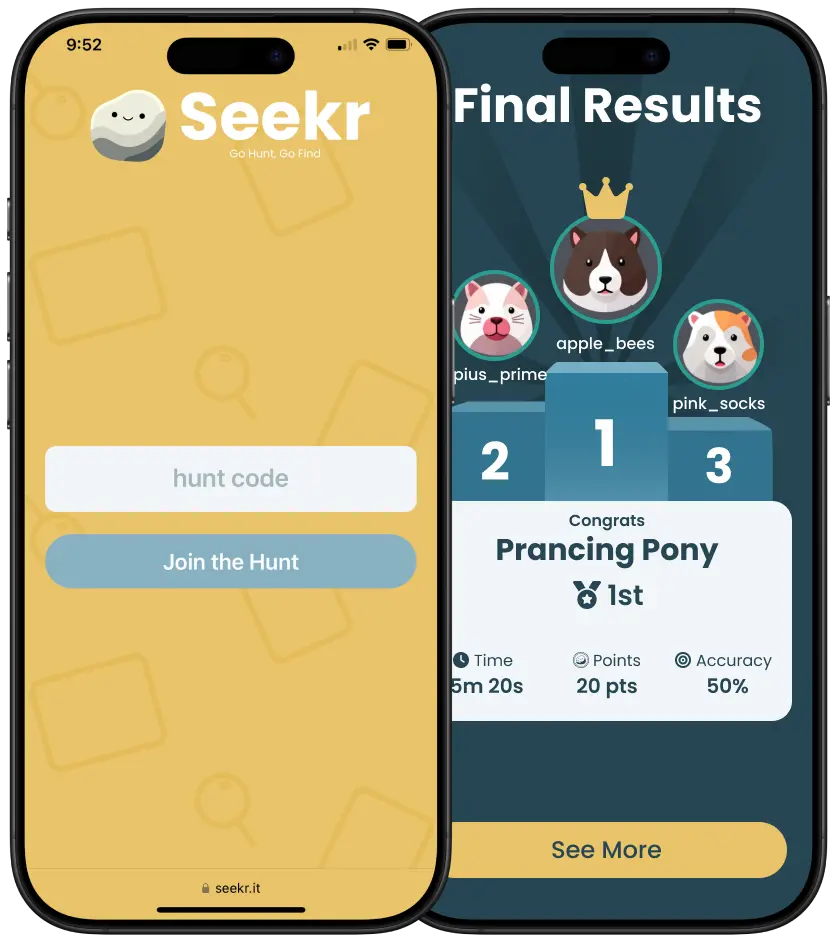
Seekr Games makes it effortless to host a professional campus scavenger hunt. Here's the step-by-step process:
Step 1: Create Your Hunt Account
Visit https://seekrgames.com and sign in (no app download required). Create a new hunt and customize it with your specific campus and event needs. The dashboard is intuitive—most hunts are set up in 15-20 minutes. Choose from campus-specific templates or start from scratch.
Step 2: Build Your Custom Tasks
Add each challenge as a task in the hunt builder. For each task, specify whether participants need to:
- Submit a photo
- Answer a written question
- Check in at a specific location
- Draw a picture or artwork
- Answer a multiple-choice question
Mix task types and how they are verified to keep participants engaged and challenged throughout the hunt. Vary the difficulty to maintain engagement.
Step 3: Set Hunt Duration & Rules
Define how long the hunt will run (20 minutes? 2 hours? 24 hours?), set point values for each task, and establish any rules (teams must stay together, challenges must be completed in order, etc.). You can also set difficulty levels if you want variety. Build in optional "bonus" challenges for competitive participants.
Step 4: Share via QR Code or Direct Link
Host a hunt and share a QR code or direct URL. Send it to participants via email, text, social media, or print it on event posters. Participants simply scan the QR code or visit seekr.it, enter the hunt code, and begin immediately. No installation, no account creation needed.
Pro tip: Create a branded event page on your organization's website or social media with the QR code and clear instructions. Include a start time, estimated duration, and any prizes. Participants love having all the details in one place and higher visibility = better participation.
Step 5: Watch Submissions in Real-Time
Monitor submissions as they come in through the Seekr dashboard. The system displays:
- Real-time leaderboard (who's winning?)
- Incoming photo submissions with timestamps
- Team progress and completion status
- AI verification of photo challenges (did they really find what they were looking for?)
You can manually approve, request resubmissions if needed, or award bonus points for creative submissions. The system makes it easy to adjust on the fly if a challenge proves too difficult.
Step 6: Celebrate & Share Results
Once the hunt ends, share the results with your campus community:
- Announce winning teams at your next event
- Post the best photos to your organization's social media (with permission)
- Create a gallery of memories for participants to relive the experience
- Award small prizes or recognition to top teams
- Use photos in recruitment materials or publications
The Seekr Games platform automatically collects all submitted photos and creates a lasting digital memory of your event—no additional photo compilation needed.
Pro Tips for Successful College Campus Scavenger Hunts
1. Scout Your Locations First
Before launch day, walk your participants' likely routes. Check that all locations are accessible and safe. Note any construction, special events, or restricted areas that might affect the hunt. Update challenges if access is limited. This 30-minute investment prevents major issues on event day.
2. Customize for Your Campus Size
A large campus (1,000+ acres) needs different challenges than a smaller urban campus.
For large campuses:
- Use public transit information in hunt instructions (bus routes, shuttle services)
- Spread challenges across accessible areas or multiple "zones"
- Consider time needed to travel between locations (build in buffer time)
- Concentrate popular activities in a 15-minute walking radius for most participants
For small campuses:
- Concentrate on deep exploration of specific areas
- Include more detailed challenges (find specific artifacts, interview people)
- Allow longer hunts without making it exhausting
- Create variation through different building types (academic, administrative, recreational, residential)
3. Plan Your Hunt Timeline Strategically
- 20-30 minute hunts: 8-12 challenges concentrated in one building or quad area (great for class integration)
- 45-60 minute hunts: 15-25 challenges covering one academic area or central campus
- 2-hour hunts: 30-40 challenges spread across broader campus
- Half-day hunts (3+ hours): 40-50+ challenges, full campus exploration with breaks built in
4. Make It Genuinely Inclusive
- Include challenges that don't require running or mobility (photo challenges from accessible areas, interviews, knowledge questions)
- Offer alternative task options for participants with different abilities
- Provide accessibility information for all campus locations (wheelchair accessible routes, accessible restrooms, etc.)
- Schedule hunts around campus accessibility—avoid peak class times or crowded periods
- Allow virtual participation for students who cannot attend in person (photo submissions from home count too)
- Consider sensory-friendly options (quiet spaces, less crowded times) for neurodivergent students
5. Encourage Discovery of Hidden Gems
Mix well-known campus landmarks (student center, library, main quad) with hidden discoveries (lesser-known art installations, quiet study areas, scenic overlooks, unique campus shops). This authentic exploration helps participants truly learn their campus and discover personal favorites they'll use for years.
6. Build Community Through People Challenges
Include tasks that require interacting with others, not just visiting locations:
- Talk to 5 students and collect fun facts about them
- Meet an RA or faculty member and ask a question
- Find someone from a different major and learn about their field of study
- Interview someone in campus administration
These human connection moments often become the hunt's most memorable parts and foster genuine campus community.
7. Provide Context & Purpose
In your hunt description and materials, explain WHY you're doing this:
- For new students: "Learn your campus and meet future friends who'll be your college family"
- For RA training: "Bond as a leadership team and explore where your residents will live"
- For Greek life: "Build chapter unity and strengthen campus pride in our community"
- For clubs: "Discover your organization's place in campus culture and celebrate our impact"
Purpose increases motivation and helps participants feel connected to the experience—they're not just playing a game, they're building community.
8. Have a Weather Backup Plan
Outdoor hunts are great until it rains. Have a backup plan ready:
- A set of indoor-only challenges for bad weather days
- A rain date option communicated to participants
- Hybrid hunts that can move indoors (photo challenges of indoor locations)
- Seasonal adaptations (winter hunts with different challenges than spring hunts)
- Clear communication about the backup plan in advance
9. Use Photo Verification to Prevent Cheating
Set photo tasks to require:
- Clear visibility of campus landmarks, building signs, or distinctive features
- Team members visible in photos (prevents solo participants taking photos for others)
- Timestamp verification through the app
- Specific task completion markers (holding a sign, making a gesture, etc.)
This maintains hunt integrity while making it more engaging and authentic. Most participants enjoy the genuine challenge.
10. Celebrate Widely & Create Lasting Memories
Don't let the hunt end when the competition does:
- Post winning photos on your organization's social media (tag participants!)
- Feature participants in newsletters or campus announcements
- Share a digital album with all participants
- Recognize top teams at your next event or gathering
- Use hunt photos in recruitment, marketing, or promotional materials (with permission)
- Create a wall display of photos in your office or dorm
This celebration extends the positive feelings and encourages future participation—participants become ambassadors for your organization.
Frequently Asked Questions About College Campus Scavenger Hunts
How long should a college campus scavenger hunt take?
Answer: Duration depends on your event type and audience. For orientation week, 20-45 minutes works well to keep attention and fit within a packed schedule. For a dedicated evening event or weekend activity, 1-2 hours keeps engagement high without fatigue. Weekend events can extend to 2-3 hours with built-in breaks. Generally, longer hunts aren't better—the sweet spot is enough time for real exploration without burning out participants. Test your hunt with a small group first to estimate completion time accurately.
What if some students can't access certain campus areas?
Answer: Design your hunt with multiple routing options. Allow teams to choose alternate tasks in restricted areas, or build in alternative photo challenges that don't require access to specific locations. This is especially important for students with mobility disabilities, visual or hearing impairments, or other accessibility needs. The goal is participation for all, not obstacle courses. Consult with your disability services office when designing hunts to ensure genuine accessibility.
Do participants need to download the Seekr Games app?
Answer: No! Seekr Games works entirely through your phone's web browser. Participants simply tap the link, enter their team name, and start the hunt. No app store, no waiting for downloads, no extra steps. It works on any smartphone (iPhone or Android), tablet, or device with internet access. This is a huge advantage—everyone can participate immediately with zero friction or technical barriers.
How do we prevent cheating in a campus scavenger hunt?
Answer: Seekr Games has built-in anti-cheating features including timestamp verification, photo analysis, and geolocation checking for specific challenges. The platform can remove completed tasks if cheating is detected. You can also spot-check photos in real-time and request resubmissions. Most participants self-police in team settings—the social dynamic naturally discourages cheating.
Can we show photos to participants during the hunt?
Answer: Yes! You can pre-load campus photos into Seekr for participants to identify ("Find this location and get a selfie there"), or create "I Spy" style challenges. This variation works especially well for scavenger hunt veterans or staff training. Photo-matching challenges add cognitive complexity and visual engagement beyond standard location hunts.
What's the best time of day to run a campus scavenger hunt?
Answer: Avoid peak class times (9 AM to 3 PM on weekdays). Ideal times include:
- Early morning (7-8 AM before classes start)
- Evening (5-7 PM after classes end, great for weekday events)
- Weekends (Saturday or Sunday afternoon when more students are available)
- For orientation: During welcome week (first few days) when campus is focused on student engagement
- For RA training: During staff retreats or the week before students arrive
Pro tip: Check your campus calendar for conflicts with major events, holidays, or exam periods. Avoid midterms and finals weeks when students are most stressed.
How many challenges should a campus scavenger hunt have?
Answer: This depends on hunt duration and difficulty:
- Short hunts (20-30 min): 8-12 challenges
- Medium hunts (45-60 min): 15-25 challenges
- Long hunts (2+ hours): 30-45+ challenges
Balance quantity with quality. A few well-designed challenges that create genuine exploration and discovery beats dozens of trivial tasks. Aim for variety in challenge types and locations to maintain engagement.
Can we run a college campus scavenger hunt indoors if weather is bad?
Answer: Absolutely. You can create indoor-only hunts targeting campus buildings, libraries, student centers, and academic facilities. Indoor hunts work great for rainy days, winter conditions, or as a fully indoor alternative. Many organizers have both outdoor and indoor hunt versions ready to deploy based on conditions—this flexibility maximizes participation regardless of weather.
How many people can participate in one hunt?
Answer: Seekr Games scales from small groups to large events. Campus hunts work well with:
- Small groups (5-20 people): Teams of 2-4 people
- Medium groups (20-100 people): Teams of 3-5 people
- Large events (100+ people): Teams of 4-6 people; you might run multiple sessions
Larger teams can slow down navigation, so find the sweet spot for your campus and event type. You can create multiple sessions of the same hunt to manage large groups effectively.
You can try out the platform for free with up to 3 people/teams joining—great for testing your hunt design before the full event.
Should campus scavenger hunt challenges be in a specific order?
Answer: You can set challenges in order (sequential) or allow free-form exploration (any order). Sequential hunts work well when you want to guide participants through a narrative or specific campus areas. Free-form hunts encourage exploration and allow teams to choose their own route based on their interests and abilities. Many organizers mix the two—required "checkpoint" challenges with optional bonus challenges throughout. Sequential hunts can help manage crowd flow; free-form hunts maximize enjoyment.
How do we award prizes for a campus scavenger hunt?
Answer: Prize options range from high-value to fun and creative:
- Team recognition (announced at next event or on social media, mention team names in campus publications)
- College merchandise (branded t-shirts, water bottles, hoodies, hats)
- Gift cards to campus bookstore, dining, or local businesses
- Reserved parking spots for a semester (for student orgs and commuters)
- Local business partnerships (pizza, coffee shop gift cards, bookstore vouchers)
- Experiences (priority registration for next event, tour of campus facilities, special dinner with leadership)
- Bragging rights (trophy, plaque, or digital badge/recognition)
You don't need expensive prizes—recognition and community celebration are often more valuable to students than monetary prizes.
Can international or graduate students join campus scavenger hunts?
Answer: Absolutely! Campus hunts are perfect for international students discovering campus resources, graduate students learning their specific college area, and doctoral candidates exploring campus beyond their labs/offices. Consider creating specialized hunts for these populations (grad student version highlighting research facilities, international student version highlighting cultural centers and international resources). Inclusive hunts build stronger campus community across all student populations.
Ready to Launch Your College Campus Scavenger Hunt?
College campus scavenger hunts transform how students explore, bond, and engage with their university community. Whether you're an RA planning a floor bonding activity, a student organization leader building community, a graduate coordinator welcoming new grad students, or an orientation coordinator welcoming first-years, a well-designed scavenger hunt creates memories that last all four years (and beyond for those who stay connected).
Seekr Games makes it easy to design, launch, and manage your hunt—no app downloads, no complex setup, no tech headaches. Just students, campus, connection, and genuine fun. You can even run multiple hunts throughout the year for different events, seasons, or student populations.
Ready to start? Visit https://seekrgames.com today to create your first college campus scavenger hunt. Choose from pre-built templates tailored to orientations, RA trainings, student organizations, graduate programs, and more—or build from scratch with complete customization.
Your campus adventure awaits. Let's get exploring.
Related Posts: